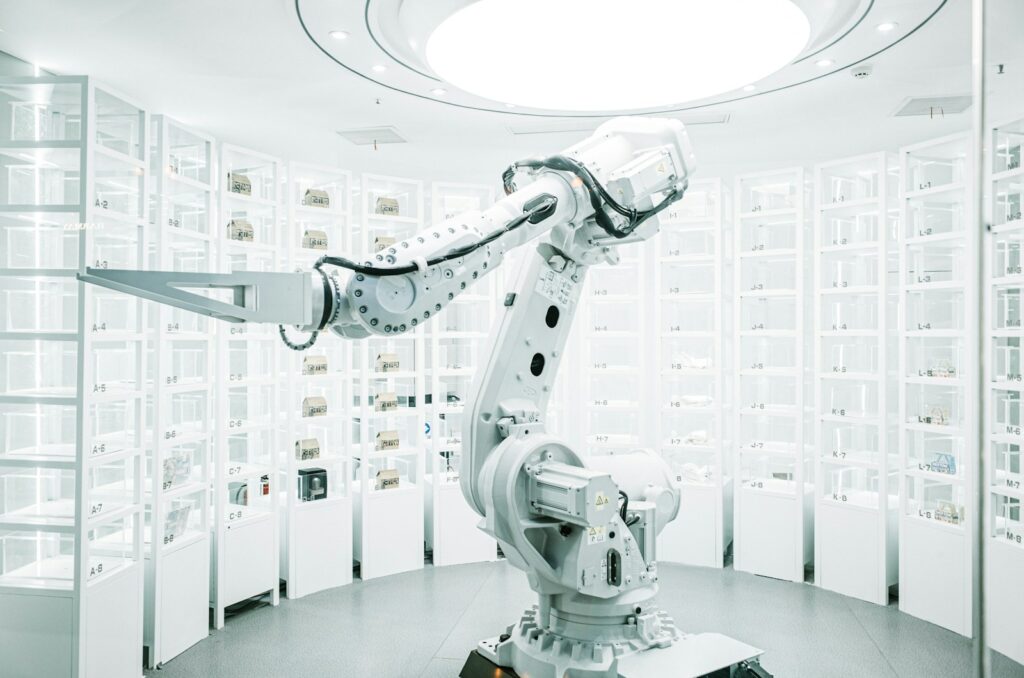
A vision-language-action (VLA) model is an AI model that takes in what a robot sees and a plain-language instruction, like “put the red cup in the sink,” and outputs the movements to do it. It combines the visual and language understanding of chatbots with robot control, and it is one of the main ideas behind the current push toward general-purpose robots.
How does a VLA model work?
It has three parts working together:
- Vision: camera images are turned into a form the model understands, so it can recognise the cup and the sink
- Language: the instruction is understood using knowledge learned from huge amounts of text and images
- Action: the model outputs motor commands, such as arm positions and gripper open or close, many times a second
Because it learned from internet-scale data, a VLA can handle objects and wording it never saw during robot training, at least sometimes.
What are examples of VLA models?
- RT-2 from Google DeepMind (2023), an early demonstration that web knowledge could guide robot actions
- OpenVLA, an open-source model from university researchers
- pi-zero (π0) from Physical Intelligence, a general robot policy for many tasks
- GR00T from Nvidia, foundation models for humanoid robots
- Gemini Robotics from Google DeepMind, built on Gemini
- Helix from Figure, for its humanoid robots
Why are VLA models a big deal?
Traditional robots are programmed for one task in one place. A VLA could, in principle, let one robot do many tasks from simple instructions, the way a chatbot handles many questions. That is the dream behind general-purpose humanoids; see what embodied AI is and physical AI and world models.
What are the limits of VLA models today?
- Data: robot action data is scarce compared with text, so teams rely on teleoperation and simulation; see the sim-to-real gap
- Reliability: success rates that look good in demos fall in messy real homes and factories
- Speed: large models can be too slow for fast, precise motion, so many systems pair a slow “thinking” model with a fast control model
- Safety: a misunderstood instruction means physical mistakes, not just a wrong sentence
Where are VLA-powered robots used now?
Mostly in pilots and research: picking and packing in warehouses, sorting, and simple household tasks in labs. Commercial humanoids like those in home cleaning trials often still rely on human teleoperators. Expect steady progress rather than overnight robot butlers; our humanoid timeline tracks it.